Wednesday, May 19, 2010
A presentation about Massar I gave in France


Friday, February 26, 2010
Lobsters
I had a very enjoyable breakfast today with three of the team which came together to create the Discovery Centre - Anne-Marie, Jan and Tom - which was a chance to revisit some old and pleasurable memories. It's good to have people say what a unique project this has been, and how special the experience of working together has been, and it's flattering to have some of that attributed to my leadership. Something else which was good to hear was that "lobster" has entered the working vocabulary. Lobster has a particular meaning in the context of the design of the discovery centre. Quite early on, when I was describing the experience that I felt visitors should get, I said that it should include something completely unexpected and quirky that made them do a double-take in disbelief, and question what they'd just seen. Something, I said, like a lobster walking upside down on a ceiling. And after that, whenever I felt the thinking was getting too conventional, I would put in a demand for the "lobster factor". And so now it's become a sort of generic shorthand, with the exhibition designers as well. It's a small legacy, but...
Labels: Massar
Monday, February 15, 2010
Catharsis
I am setting down some thoughts about what I believe we have been creating in Massar, as part of the project’s record, as a form of touchstone while life, Syria and the project move onward, and also as a background to explain more about why Massar is as it is, and a counterbalance to some prevailing perceptions. When, as is happening right now, the whole Massar team are told by the Trust CEO they are doing things wrong, that they are seen as a "spoilt" project, that Massar is a “problem”, it seems timely to put forward an alternative perspective, not least about the viewpoint of the Trust itself. Massar is different, certainly, but with reason. Whether that reason can or should remain current is a question for others to conclude. If it remains valid, the message in this paper is that it has to be appreciated, fought for and protected; if taken for granted it will dissipate and vanish, and Massar will become just another thoroughly conventional, worthy NGO.
Massar has been described on several occasions by its patron as “a small revolution”. This was not criticism but praise; a small revolution was what Syria needed, and what Massar was intended both to be and to create. Massar is about shaking the tree, making a difference, breaking a cycle. At the same time it is a project with an intellectual framework and sense of values behind what it does; it is not seeking simply to break old patterns of thinking but to shift them towards something active, positive and self-directed. Massar is aiming to build from within, not impose from outside. Any small revolution would still be founded on principles and a sense of what was good. In a similar way to those parents and teachers who often initially see the Green Team as providing aimless “fun” – not serious learning – and only later appreciate the purpose and the structure of what is going on in the activities, so Massar has an underlying learning and development structure even when on the surface it may look frivolous and random. That structure is laid out in its original project initiation documents (citizenship/ diffusion of responsibility) and the early Me++ content concepts.
One fundamental premise of Massar is that it is obsessive about its beneficiaries. At a very early (2005) presentation in Lattakia of Massar’s touring programme to its Steering Committee, I made short introductory speech in which I welcomed all the VIPs visiting (The First Lady, three senior Ministers, the Head of UNDP and the Governor of Lattakia) and said that for Massar the real VIPs present were the ones attending the workshops: the children, our beneficiaries. Trite though it was, that was and remains a completely sincere statement of Massar’s position: nothing matters more to us than engaging and inspiring our beneficiaries.
Later, in a similar way, we refused to hack about a touring event in Kafer Souseh to suit the demands of a visiting dignitary’s head of protocol (made on the basis that she could not possibly be expected to walk up some stairs); the event was for the benefit of the children, the changes would completely disrupt their experience, and the guest would please take the programme as it was. In spite of much pressure, Massar held its ground, and of course the event went perfectly smoothly. Part of Massar’s strength (part of its small revolution) is that it has principles, sticks to them, and the interests of our beneficiaries are chief among these.
This matters because if the children do not see Massar as being completely on their side, or if Massar is seen as part of the establishment, then both our rationale and chances of success disappear or are compromised. That does not mean we take children completely on their own terms; as said above we operate in a framework of what is right. But it does mean that young people trust Massar to trust them and see the best in them; to see them in terms of potential not as risk. This places Massar between Home and School as the third place in young people’s lives, where guidance and rules exist but young people feel able to explore, create and share in a space that is “theirs”. As a Massar volunteer said, “we have the potential to be bad, but Massar allows us to discover our potential to be good”.
At the same time as enabling young people to explore, Massar must have the trust and confidence of parents and communities that their young people are safe, and that being with Massar is not pushing them outside a cultural comfort zone or storing up future trouble with the establishment. Where these boundaries lie is often unclear and not even consistent within communities, and for Massar any and every event or programme is subject to fine tuning and adjustment as the particular characteristics of one location or group and another are taken into account. Arguably this is a criticism of the project’s development (it should be building pockets of replicable practice). Equally arguably, Massar is in a process of constant evolution and change and will be for some years yet, there is little benefit in building one-size-fits-all solutions, and in the context of generational change four years is a tiny period.
One element of the way Massar (at least at senior level) thinks of itself is that if Massar were successful, there would be no further need for us. If, as we are, Massar is about empowering young people to shape their lives then Massar is in the business of making itself redundant. Another is that we don’t mind other organisations being in our territory, even those blatantly copying what we do. For Massar, the more the merrier – IF it all has the effect of inspiring and engaging young people.
A third is the empowerment of Massar people at all levels of the organisation, founded on respect and decent treatment for all, giving them the chance to grow and feel part of the whole. We encourage risk-taking, accept the possibility of failure, welcome the chance to learn from it. People are able to fail, learn and do better. It's tough for some to appreciate, tougher to practise, and I can say that we haven’t always done well at it, but it remains fundamentally the Massar way. One thing that must be acknowledged by all is that the Massar team routinely goes above and beyond any reasonable expectation in order to deliver its activities, and does so cheerfully and wholeheartedly because it believes in the value of what it does.
Massar is not about an organisation, not about a building, not about The First Lady, not about personal prestige. It is about building an attitude, making things happen, creating social value. Massar is exploring new territory; there is little precedent for what we do anywhere let alone in Syria. So our working model is inherently experimental, learning, changing and responsive. We are not repeating or replicating a well-established template – no two days of Massar business are alike.
All of this, arguably no less today than when Massar was founded, is essentially counter-cultural in Syria, running against the grain of how things “should” be. I believe that this almost perverse desire to not fit into moulds is essential to Massar’s DNA, and at the same time one of the most difficult characteristics to maintain as part of the organisation’s culture. The easiest, and the most damaging, default path for Massar is to slip back into conformity in a society where pressures to conform are overwhelming; to observe hierarchy because it suits the hierarchical attitudes all around it, to make itself the centre of its attention rather than its beneficiaries.
Massar’s founder once also said that she hoped the Trust could embody the best of Massar. That was never likely to happen; the drivers for the Trust, its sense of priorities and its very philosophy were wholly different from those behind Massar. From early discussions where a suggestion that “humility” should be a core characteristic of the Trust was met by the management consultants’ response that on the contrary what was needed was “a lot more arrogance”, it has been clear that the philosophy of Massar and the emerging Trust were significantly different, indeed at odds. From its inception the Trust has thought and behaved as an establishment organisation.
If Massar is “about” its beneficiaries, what is the Trust “about”? The answer, at least for the last three years is that the Trust has been about itself. All that has mattered to the Trust has been that the levers and cogs of the (increasingly complex) Trust machine are put in place. Whether they are connected to any real-world outcomes or benefits, or even to each other, whether they make the Projects more efficient or effective, has simply not been a consideration. What has mattered is that an organisation is formed, with all the attendant departments, structures, systems, policies and processes that an organisation “must” have. The development of all these have been derived from the past experience of those in charge of its various pieces – nothing has been built for purpose, or with a view to how it helps fulfil the vision of an empowered society, or with an eye to innovation. Certainly nothing has started from an “if in doubt, leave it out” or “less is more” premise.
The Trust’s vision, of an organisation delivering public good in the form of an empowered society would logically have given primacy to those elements – the Projects – which most directly fulfilled that vision. A core determinant of Trust’s effectiveness would have been whether the Projects were better able to deliver their activities (in terms of effectiveness or efficiency) as part of the Trust than as stand-alone entities. A critical measure of “Service” Divisions would have been the extent to which they added value to Projects. Instead all have developed around self-defined local optima, and the questionable assumption that the Trust should best be one homogeneous uniform entity, where one size fits all. A clear, measurable value-added proposition for the Trust, externally or internally, has never been developed.
The result has been that Massar has spent more and more of its energy in servicing the needs of the Trust, however last-minute, time-consuming, irrelevant or prejudicial. Massar has helped, contributed and supported the Trust in many ways. What Massar has certainly resisted has been putting the interests of providing for its beneficiaries second to providing for the Trust. More significantly Massar has also fought against having its set of values, its culture, subsumed into those of the Trust, and so now is seen as "a problem", or "spoilt". That it should be regarded as such, for such a reason, and by such insignificant thinkers and under-achievers, is to me the far greater problem, for Massar, for the Trust and for the young people of Syria.
Labels: Massar
Sunday, February 14, 2010
Massar retrospective 2
Two common strands run through the canon of work on the subject of citizenship. First, the term citizenship is frequently conflated with direct engagement in a prevailing political process. A common citizenship “challenge”, for example in the US or UK, is seen as making politics relevant to young people and encouraging them to participate in the democratic process of electing representatives. A ”citizen” is deemed primarily to be one who properly carries out their part of the contract between a state and its people. Second, in a world of shifting populations, citizenship is increasingly intertwined with notions of nationality and legitimacy of residence in a country. This concept of citizenship touches on circumstance of birth, ethnicity, passport, and often a capacity to fit with (or indeed pass an examination in) some official doctrine of national identity.
The definition of active citizenship for Massar has centred on a different concept: that of fostering a sense of individual responsibility for achieving common good. Massar’s definition is more aligned with the current notion of “global citizens” – people who are aware that our communal global state (irrespective of national borders) results from an interconnected multitude of tiny individual choices and actions, and who are motivated to take action as individuals to make that communal state better. For Massar the outcome of citizenship is a healthy society (whether local, national or global) rather than nationhood.
The definition of active citizenship for Massar has centred on a different concept: that of fostering a sense of individual responsibility for achieving common good. Massar’s definition is more aligned with the current notion of “global citizens” – people who are aware that our communal global state (irrespective of national borders) results from an interconnected multitude of tiny individual choices and actions, and who are motivated to take action as individuals to make that communal state better. For Massar the outcome of citizenship is a healthy society (whether local, national or global) rather than nationhood.
Labels: Massar
Massar retrospective 1
Massar dates back to late 2002, and the wish by Syria’s First Lady, Her Excellency Asma Al Assad, to create a children’s museum in the country. However, during the process of defining in greater detail the purpose of such a museum in late 2004, it became clear that a much deeper and more powerful agenda for young people in Syria lay behind the First Lady’s proposal. This agenda reflected a central role for young people in building Syria’s future as a nation, the need in the country for a strong civil society as an essential complement to government and the private sector, and a strong commitment to create opportunities for young people from all walks of life.
Syria was a country in transition, and was looking to make change sustainable by building from within, respecting and retaining its distinctive cultural strengths, while investing in its long-term assets – its future generations and their whole approach to life’s new opportunities and challenges. Syria’s young people represented enormous untapped potential, not just as an economic resource but as standard-bearers for a new expression of self-directed, thoughtful and participative citizenship that could inspire and empower individuals and communities across the country.
Building active citizenship as a prevailing state of mind, in which young people would feel innately predisposed and able to seek out ways to contribute positively to their community and the wider world, while at the same time developing and fulfilling their own potential as individuals, thus became an early broad statement of purpose for Massar. Still with a children’s museum in its plan, the project’s vision and scope expanded significantly to embrace this wider social purpose.
In late 2004 there was no directly comparable project model elsewhere in the world from which Massar could draw at least basic empirical information for the design of its programmes. The emerging Massar strategy outlined a wide-ranging, national but non-governmental initiative, offering non-formal learning opportunities to young people between the ages of 5 and 21 (initially the upper age was 15, later extended). From these opportunities they could explore and develop their own potential, for their own individual fulfilment and success, and for the good of others. As a non-governmental organisation, Massar had no remit to intervene in the formal education system or any other aspect of government provision; its programmes would be independent but complementary. A long-term view would be taken of outcomes; some results might be seen immediately, but the embedding of changed attitudes and behaviour was expected to take years if not generations. In a Massar project initiation document from February 2005 its broad aim was captured as follows: ’At the heart of this project is the concept of building “active citizenship”, in which children’s growing understanding and appreciation of themselves and the world around them leads to greater direct individual responsibility and involvement. This responsibility and involvement might manifest itself in environmental or social activity, volunteering and pro bono public work, the forming of interest groups and knowledge communities, wider public debate on important issues, or in a broad range of creative outcomes. As a whole, it should stimulate new generations to be aware of issues, challenges and opportunities, to be concerned to tackle them, and to look for actions they can take by themselves or with others.’ A number of specific characteristics were included in the original design of Massar’s programmes, as follows:
The Massar discovery centre being built in Damascus has thus a very different intended character from a conventional children’s museum or science centre. It will take visitors on a hands-on critical thinking journey through six main topic areas called: Beginnings, Life, Our World, Ideas, Achievements, and You Can Do It. Beginnings shows how each individual is an active part of a larger whole, whether family, community, country or world. Life examines the complex connections within the living world, and mankind’s impact on it. Our World deals with the physical and inanimate world, and the risks in taking it for granted. Ideas looks at how we learn and form impressions, how our minds can sometimes be tricked, and how we create ideas, concepts and plans. Achievements looks widely at what constitutes an achievement, at lessons from the past, and at the law of unforeseen consequences. You Can Do It invites visitors to take on some aspect of active citizenship. Both the journey as a whole and the interactive treatment of each topic embody the sequential learning steps, with a resource library at the journey’s end providing the means for visitors immediately to start putting Engagement into practice. Though providing a great deal of subject knowledge as the basis for understanding and empathy, all the centre’s exhibits and activities pose questions, make connections, challenge preconceptions and raise issues, inviting young people and families to think, choose and act, not just in the centre itself but outside in the real world.
Massar’s regional centres – smaller spaces distributed across Syria providing exhibitions, activity programmes and resources, usually focussed on a subject theme – have a similar emphasis on encouraging young people to explore their world critically and develop their own potential. These centres can also play a direct role in the life of the local community, and they offer young people the platform on which they can develop pro-social awareness and habits, and the tools to put helping behaviour into practice. The centres encourage repeat visits, and build strong sense of ownership and responsibility for “their” centre among young users. The first regional centre opened in 2007 in Lattakia, and two more are currently in preparation, in Homs and Aleppo.
Massar’s touring activities have been running nationally since 2005, and though these are relatively brief one-off “permission” encounters, they are very catalytic. For younger age groups, a stage show about learning through our senses is followed by story-telling (stimulating the imagination) and an “archaeological dig” (practising touch, sight and analysis). For teenagers, the sessions are managed as a debate about identity, rights, and issues that the children themselves want to discuss. Working in teams, the teenagers produce a newspaper front page and a video clip about the subjects they choose. These debates have covered topics such as immigration, housing, violence, health and work. For many of the teenagers involved this is the first time they have engaged in a serious discussion and felt their views are being paid attention to. The programme’s animators and facilitators – known as the Green Team – have themselves have become positive role models for the children who attend the touring activities.
The Massar web portal is designed to encourage user-generated content and user moderation of the portal community’s behaviour. It is an on-line platform offering open-source web tools, a wiki-style knowledge base, discussion forums, display space for created work and a blogosphere. It provides “safe” space inasmuch as links to potentially harmful external websites are restricted, but what the portal’s users can do within the site is deliberately left as much as possible up to them. While Massar supervises and moderates to a degree, it is made clear to users that they all share the responsibility for protecting the site from abuse.
Relating both to the on-line and real worlds, E-Volunteers launched in 2007 and its young participants achieved, among other things, the creation of what has now become Syria’s national computer database of blood donors. Volunteer projects have also included organising charity events and teaching IT skills to the blind and the old. Collaborative Learning links Syrian students with counterparts round the world to work together on a topic, which is brought together in the form of a study website. E-Debate is being developed jointly with the Open Society Institute. Here young people are given training in formal debating techniques and brought together with others from around the world to exchange perspectives and argue points of view.
Much has changed since 2004 but as far as I know Massar remains unique as a national, non-governmental citizenship initiative.
Syria was a country in transition, and was looking to make change sustainable by building from within, respecting and retaining its distinctive cultural strengths, while investing in its long-term assets – its future generations and their whole approach to life’s new opportunities and challenges. Syria’s young people represented enormous untapped potential, not just as an economic resource but as standard-bearers for a new expression of self-directed, thoughtful and participative citizenship that could inspire and empower individuals and communities across the country.
Building active citizenship as a prevailing state of mind, in which young people would feel innately predisposed and able to seek out ways to contribute positively to their community and the wider world, while at the same time developing and fulfilling their own potential as individuals, thus became an early broad statement of purpose for Massar. Still with a children’s museum in its plan, the project’s vision and scope expanded significantly to embrace this wider social purpose.
In late 2004 there was no directly comparable project model elsewhere in the world from which Massar could draw at least basic empirical information for the design of its programmes. The emerging Massar strategy outlined a wide-ranging, national but non-governmental initiative, offering non-formal learning opportunities to young people between the ages of 5 and 21 (initially the upper age was 15, later extended). From these opportunities they could explore and develop their own potential, for their own individual fulfilment and success, and for the good of others. As a non-governmental organisation, Massar had no remit to intervene in the formal education system or any other aspect of government provision; its programmes would be independent but complementary. A long-term view would be taken of outcomes; some results might be seen immediately, but the embedding of changed attitudes and behaviour was expected to take years if not generations. In a Massar project initiation document from February 2005 its broad aim was captured as follows: ’At the heart of this project is the concept of building “active citizenship”, in which children’s growing understanding and appreciation of themselves and the world around them leads to greater direct individual responsibility and involvement. This responsibility and involvement might manifest itself in environmental or social activity, volunteering and pro bono public work, the forming of interest groups and knowledge communities, wider public debate on important issues, or in a broad range of creative outcomes. As a whole, it should stimulate new generations to be aware of issues, challenges and opportunities, to be concerned to tackle them, and to look for actions they can take by themselves or with others.’ A number of specific characteristics were included in the original design of Massar’s programmes, as follows:
- Massar would explicitly aim to reach and engage with all 8 million young people in its target age range across the whole of Syria, from all walks of life. This led to an early emphasis on building activities that would take Massar to communities in all parts of the country – the national touring programme launched in 2005, the first regional resource centre in 2007, online activities in 2007, the web portal in 2009 – and only later the creation of its main discovery centre in Damascus, due in 2012. This is the reverse of the approach of most children’s museum projects, where the immediate priority is to create a museum building for audiences to visit, to be followed only later by (often half-hearted) outreach programmes within a limited catchment area. This site/destination approach works well for already motivated, mobile, middle-class children and families; it tends to disenfranchise those at a distance and those who may feel socially intimidated by the prospect of visiting. If Massar were to succeed in changing attitudes its programmes and effect should not be limited to those already predisposed towards change, but should be as universal in spread as possible. In the event, by concentrating from the start on activities that reached nationally, Massar was also able to gain an understanding of the variety of different cultural norms in areas of the country, and to design other programmes with these in mind.
- Massar should be visibly distinct from the formal establishment, especially in the area of education. Without such a distinction the risk could exist that Massar would be regarded by young people as representing the same sorts of conformity and applying the same kinds of methodology and judgement. In practice this has meant that, although schools represent one of the most effective channels to reach young people, Massar has to date run no classroom-based programmes, and has developed all its platforms itself. Furthermore, given that Massar was about encouraging self-directed attitudes and ambitions in young people, it needed to be distinct from conventional mechanisms of provision. Massar should be understood by young people as being a part of their own journey of discovery, rather than doing things for them. For example, Massar does not use formal Arabic but a more vernacular voice in talking with young people. Massar does collaborate effectively with government agencies – for example its own language cannot be at odds with that used in the classroom, otherwise children cannot apply their development in class to their non-formal learning and vice versa – but maintains a distinctly separate public face.
- Massar would aim to ingrain pro-social behaviour – what has been described as “the habits of citizenship” – through providing young people with the encouragement, tools and opportunities to practise it. Where possible, programmes would also develop empathy by having end results which would benefit needy third parties. So, for example, in 2009 a fun-run organised by Massar volunteers in Lattakia had a clear charitable purpose – to raise money for additional kidney dialysis machines for local hospitals – a pressing need. Also in 2009, a young journalists competition staged by Massar in Homs gave competing teams the task of creating video reports on the subject of local special needs groups. The result in both cases was not just an increase in the confidence and capability of the young people involved, but a new awareness of the situation of others, and their own capacity to make a positive difference.
- While its programmes would be as widespread and inclusive as possible across its 8 million national target, Massar would look to nurture catalysts, a limited number of young people who demonstrated the personality and capacity to set strong positive (“humanistic-flexible”, likely to help or intervene) examples among their peers, and so break the plurality of ignorance cycle. These young catalysts, by being likely to make an appropriate response to situations or needs, would help to redefine the shared consensus of their group.
- To do this, Massar’s programmes, places and experiences would be designed to provide young people with “permission” (within a clear framework of “safety” that would reassure both the children themselves and their parents or teachers). In many cases this requires little more than the explicit removal of the inhibitory rules that govern the formal education experience – an emphasis on avoiding failure, which discourages experimentation and innovation; the application of a single learning style; a rigid curriculum. Massar would offer young the opportunity to explore and develop at their own pace. Programmes would reward participation and endeavour, not the “right” result. Often permission would be in the form of space (real or virtual) that young people can feel is their own and within which they are given shared responsibility to form and uphold the rules. Massar’s web portal, for example, will be policed primarily by its own users, as well as by a cadre of volunteer portal champions.
- Massar would address inhibitory “rules” – wider contextual cultural constraints, expectations and norms – through the parallel involvement of parents and teachers. On one level, unless parents could feel at ease with Massar’s approach and standards, then their children would not be allowed to participate. It would be important for parents to be introduced to Massar as a concept and feel confident that it was not in any way risky or extreme. At another level, non-formal learning is best viewed as a continuous social experience, in which the learning of the child is complemented by the involvement and perspective of many others. Given the relatively limited capacity of Massar to engage with young people compared to their time in school or at home, the more teachers and parents can understand and support the Massar process the stronger it can be. In particular this involves an appreciation that children explore and learn through play, and that one of the best signs of a learning child is curiosity. An often-quoted story from the UK is of a parent who called up London Zoo to complain that “the education programme you ran yesterday was no good. My boy did nothing but ask me questions all the way home.” Massar would encourage such curiosity and enquiry, and the participation of parents and teachers would be a powerful element in their development. Both groups would be encouraged to attend and take part in activities.
- Massar would re-work the five steps to encourage intervention proposed by Latané and Darley into sequential learning stages to encourage participation. These steps would be integrated into all of Massar’s activities and especially into the way it addressed topics in exhibitions and publications:
- Understanding – Massar’s programmes would be strongly subject-based, encouraging young people to develop the skills for accessing and filtering information, analysis, critical enquiry, and building perspective from a base of relevant factual knowledge. Particular subjects and topics would be at the core of most Massar programmes and environments, and a variety of learning styles would be catered for in their presentation. This would place an emphasis on reading skills, media literacy, and field or on-line research.
- Choices and implications – Massar’s programmes would encourage young people to go beyond factual knowledge to seek out underlying issues and causes, to appreciate the implications of human action (or inaction), and to examine the choices that situations offer. With a small number of non-contentious exceptions, Massar would not promote any social agenda; the aim would be to encourage young people to reach their own conclusions.
- Responsibility – all Massar’s content and programmes would also aim create a direct connection between the appreciation of a situation and the recognition by participants of their personal connection with it and responsibility towards it.
- Engagement – Massar would work with young people to stimulate in them some form of direct response or action. Massar would not prefer any particular type of response; it might be creative, expressed in art or photography, or a collaborative group project, in the virtual or real world. Young people might help others or develop themselves, perhaps by choosing to study a subject further. What would matter was that young people had chosen to take some action.
- Empathy – at the highest level Massar would seek to build into its activities and experiences an awareness of and feeling for the situation of others, in Syria and the rest of the world.
The Massar discovery centre being built in Damascus has thus a very different intended character from a conventional children’s museum or science centre. It will take visitors on a hands-on critical thinking journey through six main topic areas called: Beginnings, Life, Our World, Ideas, Achievements, and You Can Do It. Beginnings shows how each individual is an active part of a larger whole, whether family, community, country or world. Life examines the complex connections within the living world, and mankind’s impact on it. Our World deals with the physical and inanimate world, and the risks in taking it for granted. Ideas looks at how we learn and form impressions, how our minds can sometimes be tricked, and how we create ideas, concepts and plans. Achievements looks widely at what constitutes an achievement, at lessons from the past, and at the law of unforeseen consequences. You Can Do It invites visitors to take on some aspect of active citizenship. Both the journey as a whole and the interactive treatment of each topic embody the sequential learning steps, with a resource library at the journey’s end providing the means for visitors immediately to start putting Engagement into practice. Though providing a great deal of subject knowledge as the basis for understanding and empathy, all the centre’s exhibits and activities pose questions, make connections, challenge preconceptions and raise issues, inviting young people and families to think, choose and act, not just in the centre itself but outside in the real world.
Massar’s regional centres – smaller spaces distributed across Syria providing exhibitions, activity programmes and resources, usually focussed on a subject theme – have a similar emphasis on encouraging young people to explore their world critically and develop their own potential. These centres can also play a direct role in the life of the local community, and they offer young people the platform on which they can develop pro-social awareness and habits, and the tools to put helping behaviour into practice. The centres encourage repeat visits, and build strong sense of ownership and responsibility for “their” centre among young users. The first regional centre opened in 2007 in Lattakia, and two more are currently in preparation, in Homs and Aleppo.
Massar’s touring activities have been running nationally since 2005, and though these are relatively brief one-off “permission” encounters, they are very catalytic. For younger age groups, a stage show about learning through our senses is followed by story-telling (stimulating the imagination) and an “archaeological dig” (practising touch, sight and analysis). For teenagers, the sessions are managed as a debate about identity, rights, and issues that the children themselves want to discuss. Working in teams, the teenagers produce a newspaper front page and a video clip about the subjects they choose. These debates have covered topics such as immigration, housing, violence, health and work. For many of the teenagers involved this is the first time they have engaged in a serious discussion and felt their views are being paid attention to. The programme’s animators and facilitators – known as the Green Team – have themselves have become positive role models for the children who attend the touring activities.
The Massar web portal is designed to encourage user-generated content and user moderation of the portal community’s behaviour. It is an on-line platform offering open-source web tools, a wiki-style knowledge base, discussion forums, display space for created work and a blogosphere. It provides “safe” space inasmuch as links to potentially harmful external websites are restricted, but what the portal’s users can do within the site is deliberately left as much as possible up to them. While Massar supervises and moderates to a degree, it is made clear to users that they all share the responsibility for protecting the site from abuse.
Relating both to the on-line and real worlds, E-Volunteers launched in 2007 and its young participants achieved, among other things, the creation of what has now become Syria’s national computer database of blood donors. Volunteer projects have also included organising charity events and teaching IT skills to the blind and the old. Collaborative Learning links Syrian students with counterparts round the world to work together on a topic, which is brought together in the form of a study website. E-Debate is being developed jointly with the Open Society Institute. Here young people are given training in formal debating techniques and brought together with others from around the world to exchange perspectives and argue points of view.
Much has changed since 2004 but as far as I know Massar remains unique as a national, non-governmental citizenship initiative.
Labels: Massar
Thursday, January 14, 2010
Leaving
So, after more than five years I am soon stepping down as CEO of Massar and handing the reins on to others to hold from here onwards. I have very mixed feelings about doing so, but it had to happen sometime, probably should have been done two years earlier, and I haven't been giving my family the time and attention they deserve for far too long. And actually, it's a big weight lifted; the job here has for many reasons become too bureaucratic, too political, too inward-looking - none of these things being my forte. The team is more than able to take on my responsibilities now, and Massar will thrive. I am finishing here at the end of March, spending a couple of weeks with Helen as tourists creating great memories of Syria to take away, and then heading back to the UK for some serious decompression time. My personal investment here is enormous, and I won't go without a lot of emotion. But I will be back in the future, often.
Even handing in my notice wasn't simple. I wrote a letter to Mrs A, only to discover some time later that her office had not passed it on to her for over a week because she was ill. So by the time we actually met to discuss it all, her opportunity to brief the incoming CEO of the Syria Trust (of which Massar is a part) had been cut short, and we ended up with all three of us sitting in the same slightly awkward meeting, rather than having an informal one-to-one chat. It wasn't the first time I had met Omar, who I think will do just fine as CEO of the Trust. Having the greater responsibility of Massar thrust upon him can't have made his eyes light up; there is plenty of deep surgery he will need to do to get the Trust in any sort of productive shape, including getting rid of some very senior managers. But he's a big boy, with plenty of support to make his responsibilities a little bit easier.
Even handing in my notice wasn't simple. I wrote a letter to Mrs A, only to discover some time later that her office had not passed it on to her for over a week because she was ill. So by the time we actually met to discuss it all, her opportunity to brief the incoming CEO of the Syria Trust (of which Massar is a part) had been cut short, and we ended up with all three of us sitting in the same slightly awkward meeting, rather than having an informal one-to-one chat. It wasn't the first time I had met Omar, who I think will do just fine as CEO of the Trust. Having the greater responsibility of Massar thrust upon him can't have made his eyes light up; there is plenty of deep surgery he will need to do to get the Trust in any sort of productive shape, including getting rid of some very senior managers. But he's a big boy, with plenty of support to make his responsibilities a little bit easier.
Labels: Massar
Tuesday, December 22, 2009
Feels good
A comment on Facebook about Massar from one of our great volunteers in Lattakia, Ahmad Shallouf "Well.. Here's the thing, the first lady said to us once that one hand cannot clap on its own so.. We must thank you all for giving us the opportunity.. Without you we couldn't have done anything either.. It was quite letterally the best experience of my life, Massar.. And its still going.. It still is.."
Labels: Massar
Friday, December 11, 2009
Open house at the Lattakia centre
To launch the new IT/Debate part of the centre we threw a party, and just a few more people came than we were expecting...
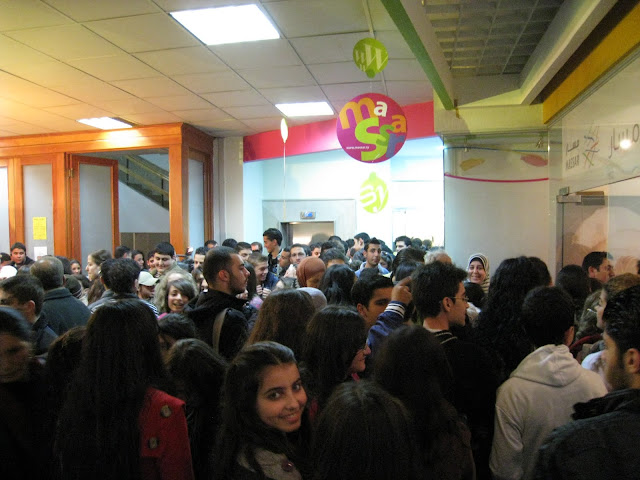


Labels: Massar
Wednesday, November 11, 2009
An end in sight
Well, I have finally done it. I've just sent a letter of resignation to Mrs Assad, proposing that I step down at the end of March next year. We had discusssed the possibility that I might move from this role on to a sort of Chairman role, but I now believe I should cut the knot completely. It's never a pleasant thing to do, but for all sorts of reasons I feel it is the best thing for me, the family and for the project, although it may take people some time to see the latter. Anyhow, it's final, and I will have to wait for her response to see how we go forward.
Labels: Massar
Saturday, July 25, 2009
Massar People at the OIF event - photos by Kais


Tuesday, July 07, 2009
More images from the activities


Wow!
We are just coming to the end of two weeks of outdoor activities on the 
 site of our future discovery centre, which have been a huge success. By the end of this week around 15,000 people will have visited, and the profile of Massar has suddenly shot through the roof. Some of this is because the President visited a few days ago, but a lot is just due to the fact that the activities are fun and worthwhile, they are free and convenient, and they are happening in the very centre of the city.
The weather has been unkind in making the second week very windy, which has ruined a spectacular water and light show we had planned to run each evening, and some of our activities have had to be cut short, but the enjoyment goes on. Very very hard work, but extremely rewarding. The essence of Massar captured.


Labels: Massar
Monday, July 06, 2009
Involving young people in the process
The challenge for Massar is to increase the direct participation of young people – the consumers of Massar – into the process of design and content development for the Discovery Centre. This means much more than just involving them in testing and prototyping. While that is all useful and in many ways an expected part of an effective design and content development process, our aim is for us to go further than that. In principle and practice we are hoping to see the “glass wall” between the design/development process and the end user removed as far as practical. In other words, we are asking all of those involved in this process how we can make young people direct participants in shaping the final experience. Not just as a means of evaluating whether “we experts” have got things right for “them amateurs” in what continues to be “our” process, but as a way of removing the distinction between us and them, and making the process shared by everyone (within reason!). In this, we are seeing the process of developing the final discovery centre experience much like any other Massar interactive programme, and asking all the team to find ways to make this activity as rich and involving as possible for our target beneficiaries.
We discussed some of the risks inherent in this, and it will be important for all involved to be clear what the windows of flexibility are as they apply differently to hardware, software and programmes, and when we need to finalise and close down discussion. It is understood that this may well be a less clear-cut (for which read more messy) process, and we may possibly end up with some stuff that is not what we would have done if left to ourselves. And there will be occasions when the functional interest of establishing something that will have a reasonable shelf-life will override a currently popular proposal from the children. So there will have to be a readiness from all for a little give and take.
We discussed some of the risks inherent in this, and it will be important for all involved to be clear what the windows of flexibility are as they apply differently to hardware, software and programmes, and when we need to finalise and close down discussion. It is understood that this may well be a less clear-cut (for which read more messy) process, and we may possibly end up with some stuff that is not what we would have done if left to ourselves. And there will be occasions when the functional interest of establishing something that will have a reasonable shelf-life will override a currently popular proposal from the children. So there will have to be a readiness from all for a little give and take.
Labels: Massar
Monday, June 29, 2009
Anas in charge - summer event

Wednesday, June 24, 2009
Points for the media
Active citizenship: young people participating in positively shaping our society and world. Active citizenship is when members of a community take steps to shape their own circumstances and future, and contribute productively to building their country. It requires a spirit of participation, initiative and responsibility. It is the shape of Syria’s future.
Massar was created to inspire and empower young people in Syria to explore their world, develop life skills and make a positive contribution to their community.
Through…
Responsibility: young people taking on a duty of care or leadership on behalf of themselves and others. Young people are taking responsibility in all sorts of ways eg: leadership of a sports team or youth group, a child looking after an ill parent, a young person taking the personal decision not to smoke cigarettes or to eat healthily
Volunteering: young people giving time and capability to help for the public good. Volunteering is an effective way in which any individual can make a difference, by giving their time to help a charity, a project or an organisation working for the public good.
In Massar: blood donor database project, Lattakia marathon, teaching IT skills to blind, old
Creativity: young people developing artistic, technical, physical and thinking skills. Young people have extraordinary potential to contribute in a variety of ways. Their innate creativity may form the basis of a possible career, or a lifelong interest. In particular, young people are encouraged to develop thinking and learning skills which will equip them to succeed throughout a lifetime of change.
In Massar: music composing, Amwaj choir, touring programme, ICT applications
Connection: young people linking productively to others in Syria and worldwide. Building links with other individuals and communities worldwide helps to build cultural understanding, spreads positive impressions of Syria, and enriches Syria’s tradition of tolerance. Creating such links within Syria builds connections between people of different regions and encourages the celebration of Syria’s diverse cultural heritage.
In Massar: e-debate programme, collaborative learning projects
Labels: Massar
Wednesday, June 10, 2009
Hard times
A fraught few months, one way or the other. I am preparing to divide my time more equally between the UK and Syria, so changing my role somewhat, which is causing some complicated knock-on effects. Work pressure is sky-high, recently augmented by the sudden expansion of a simple ceremonial to mark the start of the construction of the discovery centre into a major national event, all to be organised within a month - including finding the money for it. Massa has said she plans to leave later in the year, which is making me look again at the organisation structure. Budget allocations for this financial year are incredibly (as in horriby) tight: we are looking to fundraise around $3 million if we are going to achieve this year's plans. We have raised over $1 million already, but the hill is getting steeper by the day. Ironically, all the funding has suddenly arrived for another project which we had put onto the back-burner as it had previously gone cold. So, as often happens, we have too little money to do the things we were planning for, and all the money needed for something we weren't planning for. The office is now working seven days a week and long hours each day just to keep up.
Labels: Massar
Monday, March 30, 2009
This CAN work!
Back at the start of the project, in 2005, I wrote a planning document, where I set out what Massar was aiming to achieve. Citizenship, responsibility, pride, empathy, choices, action, ownership of issues, contribution; these were all things I stated that the project wanted to build in Syria's young people. To be honest, it all sounded very much like wishful thinking - warm, fluffy, unquantifiable stuff.
Today I've just watched a video of interviews with young people in Lattakia with whom Massar has been working. This was uncoached, unprompted feedback about what they now think about their place in the world. And it's all there! The choice to be creative rather than destructive. The value of helping others. The discovery of one's own potential. The need to do something within the community. And best of all, this has been their own process of change and discovery, with Massar enabling rather than steering.
It's always difficult to measure the impact of what a programme like Massar does, but if ever anyone asks how we know if we're making a positive difference, from now on I will sit them down and show them this video. It's just completely inspiring to know we can make this happen.
Some clips from the video here:
Labels: Massar
Thursday, March 19, 2009
Good feelings

Monday, March 16, 2009
Charity marathon in Lattakia
 A group of young Massar volunteers (middle picture) came up with the idea of organising a charity marathon to raise money for kidney dialysis machines. It took place on Friday in Lattakia and over 1500 people took part. It looks as if we may have already secured three dialysis machines, and money is still coming in. What a fantastic example of what Massar is about!


Labels: Massar
Thursday, November 20, 2008
Impressions of the Massar discovery centre


Subscribe to Posts [Atom]